Product Testing
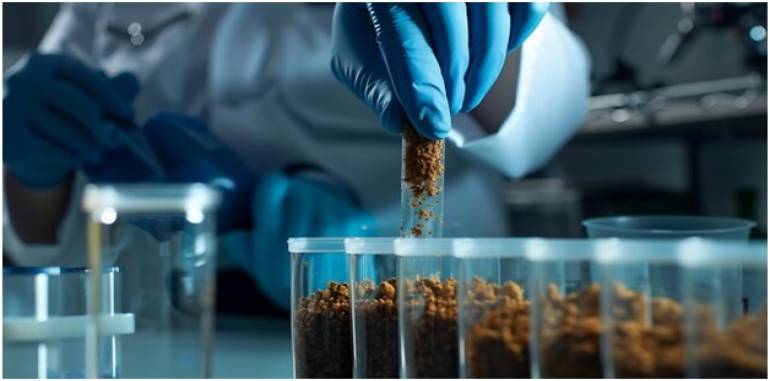
Soil Testing
WHAT IS SOIL TESTING?
Soil testing is a scientific process that analyzes
soil properties to determine its suitability for agricultural, environmental,
and engineering purposes. It
provides valuable information about soil fertility, nutrient content, pH, contaminants, and physical
characteristics, enabling informed decisions for crop management, land
development, and environmental conservation. Soil testing is essential for
maximizing crop yields, managing soil health, and minimizing environmental
impact.
IMPORTANCE OF SOIL TESTING
1.
Nutrient
Management: Helps determine the
nutrient content of soil, guiding fertilization for optimal crop growth.
2.
Environmental
Protection: Identifies
contaminants, minimizing soil and water pollution through targeted treatment or
remediation.
3.
Crop
Selection and Rotation: Assesses
soil suitability for different crops, helping farmers choose crops based on
soil conditions.
4.
Erosion
Control: Evaluates soil
structure and composition, aiding in erosion prevention and soil conservation
efforts.
5.
Engineering
and Construction: Tests soil stability,
moisture, and load-bearing capacity for construction projects.
6.
Soil
Health Monitoring: Tracks changes in
soil quality over time, allowing for sustainable soil management practices.
TYPES OF SOIL TESTING
7.
Agricultural
Soil Testing: Primarily assesses
nutrient levels, pH, organic matter, and soil texture to support agricultural
productivity.
8.
Environmental
Soil Testing: Identifies
contaminants (e.g., heavy metals, pesticides) in soil to protect public health
and the environment.
9.
Geotechnical
Soil Testing: Measures soil
properties for construction and engineering, including stability,
compressibility, and moisture content.
10.
Soil
Fertility Testing: Evaluates soil
nutrient levels and pH to guide fertilization and amendments for optimum crop yield.
11.
Soil
Health Testing: Analyzes biological,
physical, and chemical properties to assess soil’s long-term sustainability and
productivity.
12.
Forestry
Soil Testing: Tests soil
characteristics to aid forest management and the selection of suitable tree
species.
KEY SOIL PROPERTIES ASSESSED IN TESTING
13.
Chemical
Properties:
14.
pH:
Indicates soil acidity
or alkalinity, influencing nutrient availability and microbial activity.
15.
Macronutrients: Levels of primary nutrients like nitrogen
(N), phosphorus (P), and potassium (K), essential for plant growth.
16.
Micronutrients: Includes iron, manganese, zinc, copper,
molybdenum, and boron, which are vital in smaller amounts.
17.
Organic
Matter: Measures decomposed
plant and animal residues that affect soil structure, moisture retention, and
fertility.
18.
Cation
Exchange Capacity (CEC):
Soil's ability to hold and exchange cations (positively charged ions),
reflecting its fertility potential.
19.
Base
Saturation: Percentage of soil
bases (e.g., calcium, magnesium) relative to total CEC, influencing soil
structure and fertility.
20.
Physical
Properties:
21.
Soil
Texture: Proportions of sand,
silt, and clay, affecting drainage, aeration, and nutrient availability.
22.
Soil
Structure: Arrangement of soil
particles into aggregates, influencing water movement, root penetration, and
erosion resistance.
23.
Bulk
Density: Mass of soil per unit
volume, indicating compaction and porosity; high bulk density can restrict root
growth.
24.
Porosity:
Amount of pore space
in soil, affecting water retention and aeration.
25.
Moisture
Content: Amount of water in
the soil, crucial for plant growth and soil workability.
26.
Biological
Properties:
27.
Microbial
Biomass: Measures the
population of microorganisms, which play a role in nutrient cycling and soil
health.
28.
Soil
Respiration: Assesses microbial
activity by measuring carbon dioxide production, indicating organic matter
decomposition.
29.
Earthworms
and Soil Fauna: Presence and
abundance of soil-dwelling organisms, which improve soil structure and nutrient
availability.
30.
Soil
Enzyme Activity: Measures enzymes
involved in nutrient cycling (e.g., phosphatase, urease), indicating biological
soil health.
31.
Contaminants:
32.
Heavy
Metals: Levels of toxic
elements like lead, arsenic, cadmium, and mercury, which can harm plants and
humans.
33.
Pesticides
and Herbicides: Residues from
agricultural chemicals that can persist in soil and affect human health and
ecosystems.
34.
Petroleum
Hydrocarbons: Contaminants from oil
and fuel spills, which can be toxic to plants and soil organisms.
35.
Salinity
and Sodicity: High salt or sodium
levels can inhibit plant growth and degrade soil structure.
36.
Pathogens: Presence of harmful microorganisms like
bacteria, fungi, and viruses that can impact plant health.
SOIL TESTING METHODS
37.
Chemical
Analysis:
38.
Soil
Extraction Tests: Uses chemical
solutions to extract nutrients, determining available nutrient levels for
plants.
39.
Titration: Measures soil pH, alkalinity, and other
chemical properties by adding solutions and observing reactions.
40.
Spectrophotometry: Analyzes nutrient concentrations by measuring
light absorbance at specific wavelengths.
41.
Atomic
Absorption Spectroscopy (AAS): Used to determine concentrations of metals, such as lead and
cadmium, in soil samples.
42.
Chromatography: Separates compounds, commonly used to detect
organic contaminants like pesticides.
43.
Physical
Analysis:
44.
Soil
Texture Analysis: Determines the
proportions of sand, silt, and clay through sieving or sedimentation methods.
45.
Gravimetric
Method: Measures soil
moisture content by weighing soil before and after drying.
46.
Bulk
Density Test: Measures soil
compaction by determining mass per unit volume.
47.
Permeability
Testing: Assesses soil’s
ability to transmit water, important for drainage and erosion control.
48.
Atterberg
Limits: Evaluates soil
plasticity, essential in construction to understand soil's behavior under load.
49.
Biological
Analysis:
50.
Soil
Respiration Test: Measures microbial
activity by quantifying carbon dioxide release from decomposing organic matter.
51.
Microbial
Biomass Carbon (MBC):
Assesses the amount of organic carbon in the microbial biomass as an indicator
of soil health.
52.
Enzyme
Activity Tests: Measures enzymes responsible
for nutrient cycling, such as phosphatases for phosphorus.
53.
DNA
Sequencing: Identifies microbial
diversity, providing insights into soil health and resilience.
54.
Field
Tests:
55.
Penetrometer
Test: Measures soil
compaction and hardness, indicating suitability for root growth and
cultivation.
56.
Soil
Sampling: Collects
representative samples for lab analysis, with core or auger sampling methods.
57.
Infiltration
Rate Test: Determines how
quickly water penetrates the soil, critical for irrigation and erosion management.
SOIL TESTING STANDARDS AND GUIDELINES
1.
ISO
Standards: International
standards like ISO 10381-6 for soil sampling and ISO 11464 for soil quality
sample preparation.
2.
USDA-NRCS: U.S. Department of Agriculture Natural
Resources Conservation Service provides guidelines for soil testing and
classification.
3.
EPA
Soil Screening Levels (SSLs): Sets contaminant levels that trigger further investigation or
remediation efforts.
4.
ASTM
Standards: Standards for soil
testing in construction, such as ASTM D2487 for soil classification based on
particle size.
5.
FAO
Guidelines: Food and Agriculture
Organization provides guidelines on soil health and nutrient management for
agriculture.
6.
Local
Agricultural Extension Services: Provide region-specific testing protocols and interpretation
for farmers and landowners.
APPLICATIONS OF SOIL TESTING
1.
Agriculture
and Farming: Optimizes crop yields
by understanding nutrient requirements and soil health.
2.
Land
Development: Provides insights for
construction projects on soil suitability for building foundations, roads, and
infrastructure.
3.
Environmental
Remediation: Identifies
contaminated sites and guides cleanup efforts to restore soil quality.
4.
Forestry: Assists in selecting suitable tree species
for afforestation or reforestation efforts.
5.
Rehabilitation
and Restoration: Monitors soil quality
in degraded lands to support ecological restoration.
6.
Gardening
and Landscaping: Helps home gardeners
and landscapers choose suitable plants and fertilizers for healthy soil.
CHALLENGES IN SOIL TESTING
7.
Sampling
Consistency: Soil properties vary
across locations, requiring careful sampling to represent the field accurately.
8.
Testing
Costs: Comprehensive soil
testing can be expensive, especially for large agricultural fields.
9.
Temporal
Changes: Soil composition
changes seasonally, so periodic testing is needed for accurate management.
10.
Interpreting
Complex Data: Different crops and
land uses have unique requirements, making interpretation complex for users.
11.
Emerging
Contaminants: New contaminants,
such as microplastics, are challenging to detect and manage.
12.
Environmental
Impact: Soil testing
practices should minimize harm to the soil environment, avoiding excess soil
disturbance or chemical use.
FUTURE TRENDS IN SOIL TESTING
13.
Precision
Agriculture: GPS-enabled soil
sampling and testing enable precise nutrient and irrigation management across
different field zones.
14.
Digital
and AI-Driven Soil Analysis: AI and machine learning analyze large soil data sets, improving
decision-making for sustainable agriculture.
15.
Portable
Testing Devices: Handheld soil
analyzers provide rapid, on-site testing for real-time management decisions.
16.
Remote
Sensing: Satellite and
drone-based sensors analyze soil moisture, organic matter, and crop health
indicators.
17.
Increased
Focus on Soil Health:
Beyond fertility, soil testing now assesses microbial diversity, organic
matter, and indicators of long-term sustainability.
18.
📄 Document
Title: APPLICATION FORM OF SOIL TESTING
📜 Document Instructions:
Format: 📝 Word Document
Service Related FAQ
What is product testing?
Product testing is the process of evaluating a product's performance, quality, and safety by testing it in real-world conditions or controlled environments. It helps ensure the product meets the standards before reaching the market.
Why is product testing important?
Product testing is crucial to ensure: • Safety and reliability • User satisfaction • Regulatory compliance • Durability and performance • Identifying potential issues or improvements
How are products tested?
Products can be tested in various ways, including: • Lab testing: Conducted in a controlled environment to analyze specific characteristics (e.g., strength, safety). • Field testing: Evaluates the product in real-life situations. • Consumer testing: A group of target users tests the product for feedback on usability and performance. • A/B testing: Comparing two versions of a product to determine which performs better.
Who conducts product testing?
Product testing is typically done by: • In-house teams within a company • Third-party testing organizations • Focus groups or test panels made up of consumers • Independent experts or laboratories
How long does product testing take?
The duration depends on the type of product and the scope of testing. Some products can be tested in a few weeks, while others might require months of testing, especially if they involve complex safety assessments or regulatory approvals.
What types of products are tested?
Nearly any type of product can undergo testing, including: • Electronics (e.g., phones, laptops) • Clothing and textiles • Food and beverages • Health and beauty products • Automotive parts • Household items • Toys and baby products
What are the different types of product tests?
Common types include: • Safety tests (e.g., checking for harmful chemicals or risks) • Performance tests (e.g., durability, battery life, usability) • Usability tests (e.g., how easy and intuitive it is for the user) • Market tests (e.g., focus groups, consumer feedback) • Compliance tests (e.g., ensuring the product meets industry standards)
Can consumers participate in product testing?
Yes! Many companies invite consumers to participate in product testing through online panels, focus groups, or direct consumer feedback. Some even offer free products or compensation for their time.
What are the benefits of product testing?
• Identifying flaws or design issues before launch • Increasing customer satisfaction by understanding consumer needs • Reducing the risk of product recalls or lawsuits • Gaining a competitive advantage with a high-quality product
What happens after testing?
After product testing, companies analyze the data collected, make necessary improvements, and adjust the design or production process. In some cases, further rounds of testing may be necessary before the product is launched.
How do companies select test participants?
Companies typically look for participants who represent their target audience. This could be based on factors like age, location, interests, or specific product needs. Participants may be selected through online sign-ups, social media calls, or market research firms.
What are the ethical considerations in product testing?
Ethical product testing involves: • Ensuring participants' privacy and confidentiality • Obtaining informed consent from testers • Avoiding misleading or harmful tests • Offering fair compensation to testers when applicable
How can I get involved in product testing?
• Sign up for product testing programs on company websites • Join consumer testing panels • Look for legitimate product testing websites that connect testers with brands • Follow brands on social media for announcements about new tests

