Product Testing
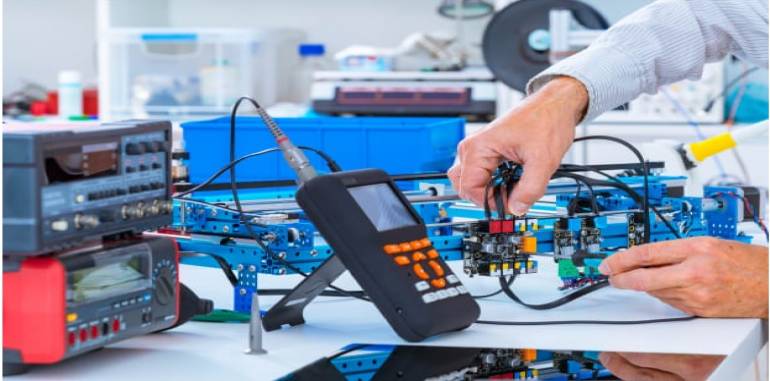
Electronics/ Electrical Testing
ELECTRONICS AND ELECTRICAL TESTING
Electronics and
electrical testing is
the process of evaluating electronic and electrical components, systems, and
devices to ensure they meet required performance, safety, and reliability
standards. Testing verifies that products are safe to use, function as
intended, and meet relevant regulatory requirements for both consumer and
industrial markets. This testing is essential in various sectors, including
telecommunications, automotive, aerospace, medical devices, consumer
electronics, and power generation.
IMPORTANCE OF ELECTRONICS AND ELECTRICAL TESTING
1.
Safety
Assurance: Protects users from
potential hazards such as electric shock, fire, and radiation.
2.
Regulatory
Compliance: Ensures products meet
local and international standards like IEC, ISO, BIS, and UL, which are
necessary for market approval.
3.
Performance
Validation: Verifies that devices
function according to design specifications under different conditions.
4.
Reliability: Confirms that products operate consistently
over their expected lifespan, minimizing breakdowns and costly recalls.
5.
Market
Access: Facilitates global
market entry by certifying that products meet country-specific regulatory
standards.
- Quality Control: Helps manufacturers detect defects early, ensuring
high quality in manufacturing and reducing warranty costs.
KEY STANDARDS FOR ELECTRONICS AND ELECTRICAL TESTING
7.
IEC
(International Electrotechnical Commission) Standards: Includes IEC 60601 (medical devices), IEC
60950 (information technology equipment), and IEC 61010 (safety for electrical
equipment).
8.
ISO
Standards: Includes ISO 9001
(quality management), ISO 14001 (environmental management), and ISO 17025 (lab
competence).
9.
UL
(Underwriters Laboratories) Standards: Safety standards for electrical devices,
widely recognized in North America.
10.
BIS
(Bureau of Indian Standards): Ensures compliance with Indian safety and performance standards
for electrical products.
11.
FCC
(Federal Communications Commission) Standards: Regulates electronic devices in the U.S. that
emit radio frequencies.
12.
RoHS
(Restriction of Hazardous Substances Directive): European standard restricting the use of
specific hazardous materials in electronics.
13.
REACH
(Registration, Evaluation, Authorisation, and Restriction of Chemicals): European Union regulation governing chemical safety in
manufacturing.
14.
MIL-STD
(Military Standards):
Military standards for reliability, durability, and functionality in defense
applications.
TYPES OF ELECTRONICS AND ELECTRICAL TESTING
15.
Functional
Testing: Verifies that devices
perform their intended functions.
16.
Component
Testing: Checks individual
components (e.g., resistors, capacitors) for conformance to specifications.
17.
System-Level
Testing: Assesses device
operation within an integrated system, ensuring interoperability.
18.
Safety
Testing: Ensures the product
is safe for consumer use.
19.
Insulation
Resistance Testing:
Measures insulation quality to prevent short circuits or leakage.
20.
Earth
Ground Testing: Verifies ground continuity
to prevent electric shock hazards.
21.
Dielectric
Withstand Testing: Applies a high
voltage to ensure insulation strength.
22.
Leakage
Current Testing: Assesses leakage
currents under normal and fault conditions.
23.
Fire
and Flammability Testing: Tests materials for fire resistance and flammability.
24.
Environmental
Testing: Determines device
resilience under varying environmental conditions.
25.
Temperature
Testing: Evaluates performance
in extreme hot or cold conditions.
26.
Humidity
Testing: Assesses product
operation in high humidity, preventing corrosion.
27.
Salt
Spray Testing: Tests for corrosion
resistance in salt environments, especially important for marine and coastal
applications.
28.
Vibration
and Shock Testing: Simulates mechanical
stress, ensuring resilience in transport and usage.
29.
Dust
and Water Resistance (IP Rating): Verifies ingress protection (IP) level to resist dust and water
exposure.
30.
Electromagnetic
Compatibility (EMC) Testing: Ensures that devices do not interfere with other electronic
equipment.
31.
Electromagnetic
Interference (EMI):
Measures emissions that may interfere with other devices.
32.
Electromagnetic
Susceptibility (EMS):
Tests the product’s resilience to external electromagnetic fields.
33.
Radio
Frequency Interference (RFI): Verifies that devices meet regulated RF emission limits.
34.
Electrical
Performance Testing:
Validates electrical characteristics and efficiency.
35.
Power
and Voltage Testing:
Measures operating voltage and ensures it aligns with design specifications.
36.
Current
and Load Testing: Evaluates device
performance under varying load conditions.
37.
Harmonics
Testing: Ensures products do
not generate excessive harmonics that can disrupt power systems.
38.
Power
Factor Testing: Checks the power
efficiency, especially important for high-load devices.
39.
Battery
and Energy Efficiency Testing: Assesses battery life and overall energy efficiency, critical
for mobile and energy-saving devices.
40.
Reliability
Testing: Confirms the product
can endure long-term use.
41.
Burn-in
Testing: Operates the product
for an extended period under controlled stress to identify early failures.
42.
Accelerated
Life Testing: Simulates an extended
period of use in a shorter time by exposing the device to higher stress.
43.
Mean
Time Between Failure (MTBF): Statistical measure of expected operational life before
breakdown.
44.
Environmental
and Chemical Testing:
Ensures safety from harmful materials.
45.
RoHS
Testing: Confirms compliance
with restrictions on hazardous substances (e.g., lead, cadmium).
46.
REACH
Compliance Testing:
Verifies compliance with EU standards for safe chemical use.
47.
Material
Composition Analysis:
Ensures components meet material safety standards for toxicity and
environmental impact.
48.
Software
and Firmware Testing: Validates
the device's software and firmware functionality.
49.
Firmware
Validation: Ensures firmware
performs as expected and integrates with hardware effectively.
50.
Software
Compatibility Testing:
Assesses software behavior on different platforms or systems.
51.
Security
Testing: Identifies and
mitigates potential vulnerabilities in embedded software.
KEY EQUIPMENT USED IN ELECTRONICS AND ELECTRICAL TESTING
52.
Oscilloscopes:
Measure and analyze
waveforms, allowing engineers to assess voltage and frequency characteristics.
53.
Multimeters: Measure voltage, current, and resistance in
electrical circuits.
54.
Power
Analyzers: Analyze power
quality, efficiency, and harmonics.
55.
EMC
Chambers: Shielded rooms used
for EMI/EMC testing, preventing external interference.
56.
Temperature
Chambers: Simulate extreme
temperatures for environmental testing.
57.
Vibration
Test Tables: Simulate real-world
mechanical stressors like vibration and shock.
58.
Insulation
Resistance Testers:
Test insulation quality, crucial for high-voltage applications.
59.
Network
Analyzers: Test electronic
networks, particularly for RF applications.
60.
Ground
Resistance Testers:
Verify grounding, critical for preventing electrical shocks.
ELECTRONICS AND ELECTRICAL TESTING LABS IN INDIA
61.
Bureau
Veritas: Offers comprehensive
testing, including EMC, electrical safety, environmental testing, and
certification for global compliance.
62.
TÜV
SÜD South Asia: Provides testing and
certification for electrical safety, EMC, environmental, and reliability
testing.
63.
UL
India: Specializes in safety
certifications and offers EMC, environmental, and electrical testing to UL and
IEC standards.
64.
Intertek
India: Conducts extensive
testing for electrical safety, performance, EMC, and regulatory compliance.
65.
SGS
India: Offers testing for
electrical and electronic products, including environmental, durability, and
safety assessments.
66.
Electrical
Research and Development Association (ERDA): Specializes in electrical testing and
certification, particularly for power equipment and infrastructure.
- Eurofins India: Provides regulatory compliance testing for
electronics, including REACH, RoHS, EMC, and environmental testing.
PROCESS OF ELECTRONICS AND ELECTRICAL TESTING
68.
Requirement
Analysis: Review product
requirements, specifications, and applicable standards to develop a tailored
test plan.
69.
Sample
Preparation and Collection: Collect representative product samples, ensuring they meet
design and quality specifications.
70.
Conduct
Testing: Perform specified
tests, including functional, safety, environmental, and reliability
assessments, based on product requirements.
71.
Data
Analysis: Analyze test data,
documenting results, deviations, and observations against expected values.
72.
Certification
and Reporting: Provide a
comprehensive test report and, if compliant, issue certification to signify
regulatory and quality standards are met.
73.
Post-Testing
Review and Improvement:
Use test data to identify and implement improvements, ensuring future
compliance and performance.
CHALLENGES IN ELECTRONICS AND ELECTRICAL TESTING
74.
Complexity
of Regulatory Compliance: Keeping up with evolving global standards for electronics, such
as RoHS, REACH, and FCC, can be challenging.
75.
Technological
Advancements: Rapid technological
changes, such as miniaturization, IoT, and 5G, require updated testing
methodologies.
76.
Cost
of High-End Testing Equipment: Advanced testing tools and facilities can be costly, especially
for high-frequency and environmental testing.
77.
Counterfeit
Components: Testing labs need to
verify authenticity to avoid counterfeits, which could compromise product
performance and safety.
78.
Data
Security: Ensuring data privacy
and cybersecurity, particularly in software and firmware testing, is crucial in
today’s connected world.
79.
Sustainability: Growing demand for sustainable testing, like
energy efficiency and reduced emissions, requires labs to adopt greener
practices.
FUTURE TRENDS IN ELECTRONICS AND ELECTRICAL TESTING
80.
AI
and Machine Learning in Testing: AI helps automate testing processes, analyze large data sets,
and predict potential failures, improving efficiency and accuracy.
81.
IoT-Enabled
Testing Systems: IoT integration
allows for real-time monitoring of product.
📄 Document
Title: APPLICATION FORM OF ELECTRONICS/ELECTRICAL TESTING
📜 Document Instructions:
Format: 📝 Word Document
Service Related FAQ
What is product testing?
Product testing is the process of evaluating a product's performance, quality, and safety by testing it in real-world conditions or controlled environments. It helps ensure the product meets the standards before reaching the market
Why is product testing important?
Product testing is crucial to ensure: • Safety and reliability • User satisfaction • Regulatory compliance • Durability and performance • Identifying potential issues or improvements
How are products tested?
Products can be tested in various ways, including: • Lab testing: Conducted in a controlled environment to analyze specific characteristics (e.g., strength, safety). • Field testing: Evaluates the product in real-life situations. • Consumer testing: A group of target users tests the product for feedback on usability and performance. • A/B testing: Comparing two versions of a product to determine which performs better.
Who conducts product testing?
Product testing is typically done by: • In-house teams within a company • Third-party testing organizations • Focus groups or test panels made up of consumers • Independent experts or laboratories
How long does product testing take?
The duration depends on the type of product and the scope of testing. Some products can be tested in a few weeks, while others might require months of testing, especially if they involve complex safety assessments or regulatory approvals.
What types of products are tested?
Nearly any type of product can undergo testing, including: • Electronics (e.g., phones, laptops) • Clothing and textiles • Food and beverages • Health and beauty products • Automotive parts • Household items • Toys and baby products
What are the different types of product tests?
Common types include: • Safety tests (e.g., checking for harmful chemicals or risks) • Performance tests (e.g., durability, battery life, usability) • Usability tests (e.g., how easy and intuitive it is for the user) • Market tests (e.g., focus groups, consumer feedback) • Compliance tests (e.g., ensuring the product meets industry standards)
Can consumers participate in product testing?
Yes! Many companies invite consumers to participate in product testing through online panels, focus groups, or direct consumer feedback. Some even offer free products or compensation for their time.
What are the benefits of product testing?
• Identifying flaws or design issues before launch • Increasing customer satisfaction by understanding consumer needs • Reducing the risk of product recalls or lawsuits • Gaining a competitive advantage with a high-quality product
How do companies select test participants?
Companies typically look for participants who represent their target audience. This could be based on factors like age, location, interests, or specific product needs. Participants may be selected through online sign-ups, social media calls, or market research firms.
What happens after testing?
After product testing, companies analyze the data collected, make necessary improvements, and adjust the design or production process. In some cases, further rounds of testing may be necessary before the product is launched.
What are the ethical considerations in product testing?
Ethical product testing involves: • Ensuring participants' privacy and confidentiality • Obtaining informed consent from testers • Avoiding misleading or harmful tests • Offering fair compensation to testers when applicable
How can I get involved in product testing?
• Sign up for product testing programs on company websites • Join consumer testing panels • Look for legitimate product testing websites that connect testers with brands • Follow brands on social media for announcements about new tests

