Training
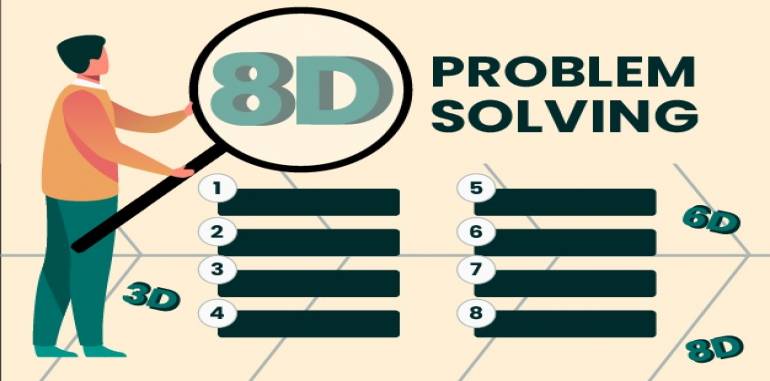
8D PROBLEM SOLVING TECHNIQUE
The 8D Problem-Solving Technique Training is designed to teach teams a structured approach to solving
complex problems, particularly those related to quality and process improvement.
Developed by Ford Motor Company and widely used in various industries,
the 8 Disciplines (8D) method focuses on identifying, correcting, and
preventing recurring issues. This training is particularly useful for
engineering, manufacturing, and service industries where quality and efficiency
are critical.
1. WHAT IS THE 8D
PROBLEM-SOLVING TECHNIQUE?
The 8D Problem-Solving
Technique is a structured, team-oriented method for identifying, analyzing, and
resolving recurring problems. The eight disciplines (steps) of this approach
guide teams through finding the root cause of an issue, implementing corrective
actions, and preventing future occurrences.
The steps in the 8D
process are:
1.
D1:
Establish the Team – Assemble a cross-functional team with the skills, knowledge,
and authority to tackle the problem.
2.
D2:
Define the Problem – Clearly describe the issue, including the "who, what, when,
where, why, how, and how many" (5W2H) to understand the scope.
3.
D3:
Containment Actions – Implement short-term actions to contain or mitigate the impact
of the problem while working on the root cause.
4.
D4:
Root Cause Analysis – Identify the root cause(s) using tools like Fishbone Diagrams,
5 Whys, and Failure Mode and Effects Analysis (FMEA).
5.
D5:
Develop Corrective Actions – Design long-term solutions to eliminate the root cause(s) and
prevent recurrence.
6.
D6:
Implement Corrective Actions – Put the corrective actions into practice, ensuring they address
the root causes effectively.
7.
D7:
Prevent Recurrence – Modify standards, procedures, and training to prevent the
problem from recurring in the future.
8.
D8:
Recognize Team Efforts – Acknowledge the efforts and contributions of the team,
reinforcing a culture of collaboration and problem-solving.
2. GOALS OF 8D
PROBLEM-SOLVING TECHNIQUE TRAINING
The primary goals of
8D training are to:
- Equip employees with the skills
to solve problems methodically and collaboratively.
- Reduce costs and losses due to
recurring issues.
- Improve product and process
quality.
- Foster a culture of continuous
improvement by developing skills in identifying and solving root causes.
- Document corrective actions and
prevention methods for future reference.
3. HOW 8D
PROBLEM-SOLVING TECHNIQUE TRAINING IS CONDUCTED
Training in the 8D
Problem-Solving Technique typically includes classroom instruction, hands-on
exercises, and case studies to reinforce each step of the 8D process. Here’s
how the training is usually conducted:
a. Introduction to 8D
Methodology
Overview of the 8D
process, its history, and its importance in quality management and
problem-solving.
Discuss the benefits
of using a structured approach like 8D to solve complex problems and prevent
them from recurring.
b. Detailed Breakdown of
Each Discipline
D1: Establish the Team: Training participants on forming
cross-functional teams, assigning roles, and utilizing diverse expertise.
D2: Define the Problem: Guidance on defining the problem clearly and
precisely, using the 5W2H approach to gather relevant information.
D3: Containment Actions:
Teaching techniques to
implement immediate actions that temporarily address the issue while working on
long-term solutions.
D4: Root Cause Analysis: Using analytical tools like the Fishbone
(Ishikawa) Diagram, 5 Whys, and FMEA to dive into root causes.
D5: Develop Corrective
Actions: Training on
developing sustainable corrective actions, including brainstorming techniques
and evaluating solution feasibility.
D6: Implement Corrective
Actions: Guidance on putting
corrective actions into place, monitoring results, and ensuring that they
effectively address root causes.
- D7: Prevent
Recurrence: Emphasis on standardizing
corrective actions through changes in policies, procedures, training, or
quality control plans.
- D8: Recognize Team
Contributions: Reinforce
the importance of celebrating team success and fostering a positive
problem-solving culture.
c. Root Cause Analysis
Tools
- Participants learn and practice
root cause analysis tools like the Fishbone Diagram, 5 Whys, and FMEA.
- Case studies and exercises
provide hands-on practice in identifying causes and working
collaboratively to find solutions.
d. Corrective Action and
Prevention Techniques
- Training emphasizes developing
corrective actions that eliminate root causes rather than just symptoms.
- Discussions on prevention
planning include documenting lessons learned and establishing new
standards.
e. Documentation and
Reporting
- Training on documenting each 8D
step in a standardized 8D report, a valuable tool for tracking issues and
corrective actions.
- Participants learn best
practices for recording key information and tracking the implementation of
corrective and preventive actions.
4. TRAINING METHODS FOR
8D PROBLEM-SOLVING
- 8D Problem-Solving Technique Training includes both
theoretical and practical learning components:
- Classroom Sessions:
Explaining each discipline in
the 8D process and discussing common challenges and solutions.
- Workshops and
Simulations: Using role-playing exercises
or simulations to apply the 8D process to hypothetical or real-world
scenarios.
- Case Studies: Reviewing examples of how organizations have
successfully applied the 8D method to solve quality issues.
- Group Exercises: Teams practice developing corrective actions and root
cause analysis using real-life examples.
- Hands-On Practice: Participants complete 8D reports, practice containment
actions, and use problem-solving tools.
5. BENEFITS OF 8D
PROBLEM-SOLVING TECHNIQUE TRAINING
8D training provides
many organizational benefits, including:
- Systematic
Problem-Solving Skills:
Teams learn a structured approach, which improves the efficiency and
effectiveness of problem-solving.
- Root Cause
Elimination: By focusing on identifying
root causes, the 8D method helps prevent issues from recurring.
- Improved Product
Quality and Consistency:
The 8D approach contributes to higher quality standards and customer
satisfaction.
- Reduced Costs: Fewer recurring problems mean reduced waste, lower
defect rates, and cost savings.
- Stronger Team
Collaboration:
Cross-functional teams bring diverse insights, promoting teamwork and a shared
sense of responsibility.
Documentation and
Knowledge Retention: 8D
reports serve as a historical record of issues, solutions, and preventive
actions, aiding future problem-solving efforts.
In summary, 8D
Problem-Solving Technique Training provides a structured framework for
identifying and eliminating root causes, improving quality, and preventing
recurring problems. By developing strong problem-solving skills and fostering a
culture of continuous improvement, 8D training helps organizations enhance
productivity, reduce costs, and deliver consistently high-quality products.

