Training
TOTAL QUALITY MANAGEMENT
Total Quality Management (TQM) training is designed to equip
individuals and organizations with the principles, tools, and techniques needed
to foster a quality-centered culture. TQM is a comprehensive approach aimed at
long-term success by focusing on customer satisfaction and continuous
improvement in all aspects of an organization.
Here's an in-depth look at what TQM
training involves and how it’s implemented.
WHAT IS TOTAL QUALITY MANAGEMENT?
Total Quality Management (TQM) is a management philosophy and structured
approach focused on embedding quality in every part of an organization. TQM
aims to:
Increase customer satisfaction by meeting or
exceeding expectations.
Empower employees at all levels to take
responsibility for quality.
Achieve continuous improvement in processes,
products, and services.
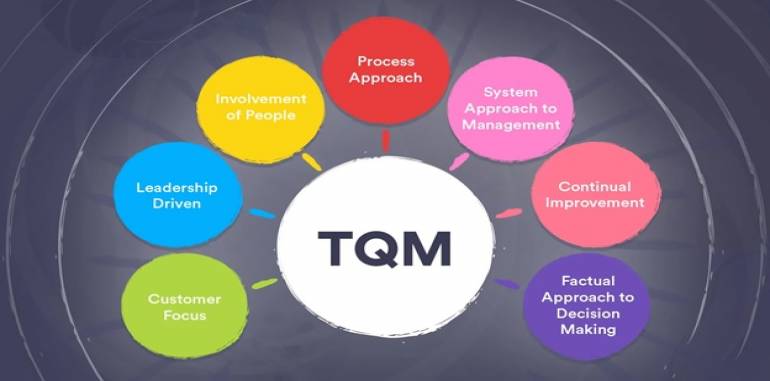
TQM is built on several core principles,
including customer focus, employee involvement, process-oriented thinking, continuous
improvement, and effective decision-making based on data and analysis.
OBJECTIVES OF TQM TRAINING
Understand TQM Principles – Learning the core principles of TQM, such as
customer focus, total employee involvement, and continuous improvement.
Implement Quality Tools and Techniques – Becoming proficient in using various quality
tools to analyze, measure, and improve processes.
Promote a Quality-Centric Culture – Cultivating a culture where quality is
everyone's responsibility.
Enhance Customer Focus and Satisfaction – Aligning processes and actions with customer
needs to ensure satisfaction and loyalty.
Establish Metrics for Continuous Improvement – Using key performance indicators (KPIs) and
other metrics to track progress and drive improvement.
HOW TQM TRAINING IS DELIVERED
1. Introduction to TQM Philosophy and Principles
Content: Overview of TQM concepts, benefits, and core principles like
customer focus, employee involvement, and continuous improvement.
Activities: Group discussions to explore real-world examples of companies
that successfully apply TQM, helping participants understand TQM's role in
competitive advantage.
Outcome: Participants develop a foundational understanding of TQM’s
purpose and benefits.
2. UNDERSTANDING AND FOCUSING ON CUSTOMER NEEDS
Content: Training on methods for identifying and prioritizing customer
needs, including techniques like Voice of the Customer (VoC) and Customer
Satisfaction Surveys.
Activities: Participants conduct a mock VoC exercise to learn how to
gather, interpret, and use customer feedback to shape quality initiatives.
Outcome: Improved skills in aligning organizational activities with
customer expectations to enhance satisfaction.
3. IMPLEMENTING QUALITY TOOLS AND TECHNIQUES
Content: Introduction to essential TQM tools such as:
Pareto Analysis – Identifying key causes of quality issues.
Cause and Effect Diagrams (Fishbone/Ishikawa) – Identifying root causes.
Flowcharts – Visualizing processes to identify
inefficiencies.
Check Sheets – Gathering and analyzing process data.
Control Charts – Monitoring process variation.
Activities: Hands-on exercises to apply these tools to sample processes,
enabling participants to practice and understand each tool’s purpose and usage.
Outcome: Enhanced ability to apply quality tools to real-world problems
and processes.
4. TOTAL EMPLOYEE INVOLVEMENT AND EMPOWERMENT
Content: Techniques to engage employees at all levels in quality
initiatives, promoting ownership and accountability for quality outcomes.
Activities: Role-playing exercises and brainstorming sessions to identify
barriers to employee involvement and generate strategies to overcome them.
Outcome: Participants understand how to foster a collaborative
environment that encourages active participation in quality improvements.
5. PROCESS-ORIENTED THINKING AND CONTINUOUS
IMPROVEMENT
Content: Training on process mapping, value stream mapping, and
continuous improvement methods such as PDCA (Plan-Do-Check-Act) and Kaizen.
Activities: Workshop exercises where participants create process maps,
identify waste and inefficiencies, and develop a continuous improvement plan.
Outcome: Ability to see processes end-to-end and understand the
importance of incremental, continuous improvement.
6. DATA-DRIVEN DECISION-MAKING
Content: Techniques for collecting, analyzing, and interpreting data to
make informed decisions, including basic statistical methods and data analysis
tools.
Activities: Exercises involving the interpretation of sample data,
identification of trends, and discussion on how to leverage insights to drive
quality improvements.
Outcome: Participants gain confidence in using data to inform decisions,
reduce variability, and improve process control.
7. ESTABLISHING METRICS AND MONITORING PROGRESS
Content: Instruction on setting and tracking key performance indicators
(KPIs) and using dashboards for ongoing monitoring of quality efforts.
Activities: Participants develop sample KPIs for hypothetical processes,
set targets, and create sample dashboards to visualize progress.
Outcome: Understanding of how to track and measure improvement efforts
systematically.
TRAINING TECHNIQUES FOR EFFECTIVE TQM TRAINING
Interactive Workshops – Practical exercises where participants work
in teams to practice tools and techniques.
Case Studies – Reviewing success stories and real-world
applications of TQM to demonstrate benefits and practical challenges.
Simulations and Role-Playing – Scenario-based learning that simulates
challenges in quality improvement, allowing participants to apply TQM concepts
in a controlled environment.
Team Collaboration Exercises – Encouraging cross-functional teams to
collaborate and gain insights into how each department contributes to overall
quality.
Continuous Improvement Projects – Assigning participants to real or simulated
improvement projects to apply TQM principles and tools actively.
BENEFITS OF TQM TRAINING
Improved Quality and Efficiency: TQM’s focus on continuous improvement leads
to better quality control and streamlined processes, reducing waste and
inefficiencies.
Increased Customer Satisfaction: TQM’s customer-focused approach helps
organizations align their products and services with customer expectations,
improving loyalty and satisfaction.
Empowered Workforce: Employee involvement and empowerment build a
sense of ownership, accountability, and a proactive approach to quality.
Enhanced Problem-Solving Skills: Training on quality tools and data analysis
methods improves employees' abilities to identify, analyze, and solve problems.
Strengthened Organizational Culture: A quality-centered culture helps ensure that
quality becomes an inherent part of every team’s work, contributing to
long-term success.
Overall, TQM training equips participants with
a structured approach to quality management, continuous improvement techniques,
and a focus on customer satisfaction to help organizations achieve sustained
competitive advantage.

