Registration

BARCODE REGISTRATION
BARCODE REGISTRATION INTRODUCTION
WHAT IS BARCODE Registration?
Barcode registration
is the process of obtaining unique identification numbers and codes that
represent products or items in a standardized format. Barcodes are essential
tools in modern commerce, logistics, and inventory management, allowing for
efficient tracking, selling, and management of goods. These codes, which can be
scanned by barcode readers, convey crucial information such as the product's
identity, price, and manufacturer.
BENEFIT BARCODE REGISTRATION
· Cost
Effective Solution
· Minimized
Human Error
· Better
Forecasting
· Accuracy
Inventory Count
PROCESS OF BARCODE REGISTRATION
Step-by-Step Process of Barcode Registration
1. Determine
Your Needs
2. Choose a
Barcode Issuing Organization
3. Obtain a
Company Prefix
4. Assign
Barcode Numbers
5. Create
Barcode Labels
6. Implement
in Systems
7. Testing
8. Maintain
Records and Compliance
TIMELINE FOR COMPLITION
Total Estimated Time
4 to 8 weeks
Overall time from
start to completion of the barcode registration process.
CONCLUSION
In conclusion, barcode registration is a critical step for
businesses aiming to improve their product identification, inventory
management, and overall operational efficiency. By following a structured
process that includes determining needs, choosing an appropriate barcode
issuing organization, obtaining a company prefix, assigning unique barcode
numbers, and creating and implementing barcode labels, businesses can
successfully integrate barcode technology into their operations.
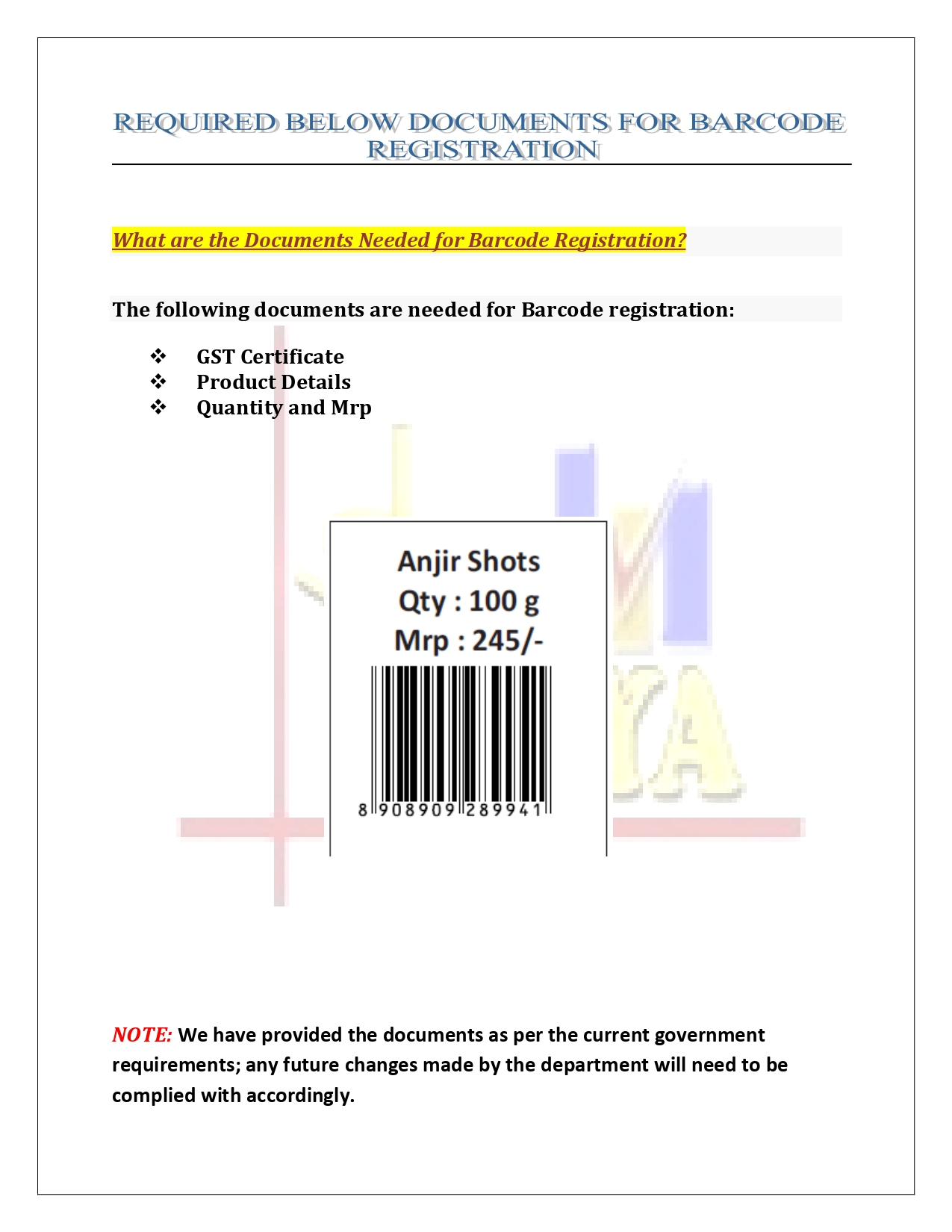
📄 Document
Title: BARCODE REGISTRATION DOCUMENT LIST
📜 Document Instructions:
Format: 🖼️ Image (JPG)
📄 Document
Title: COMAPNY PROFILE OF BARCODE REGISTRATION
📜 Document Instructions:
Format: 📄 PDF
📄 Document
Title: APPLICATION FORM OF BARCODE REGISTRATION
📜 Document Instructions:
Format: 📄 PDF
Service Related FAQ
WHAT IS BARCODE REGISTRATION?
Barcode registration refers to the process of assigning a unique barcode to a product or item. The barcode is used for tracking, inventory management, and identifying the product easily during sales or distribution. It typically involves obtaining a barcode from an official barcode authority (e.g., GS1) and registering it in their database.
WHY DO I NEED BARCODE REGISTRATION?
Barcode registration is essential for: • Product Identification: It helps uniquely identify products in retail, logistics, or warehouses. • Inventory Management: Barcodes simplify stock-taking and tracking inventory. • Retailers and Distributors: Most retailers and distributors require barcode-registered products for easy scanning and sales. • Global Trade: International businesses require GS1 barcodes to ensure global consistency and compatibility.
WHO NEEDS BARCODE REGISTRATION?
Businesses that manufacture, distribute, or sell products typically need barcode registration. This includes: • Manufacturers • Retailers • Distributors • Wholesalers • Online sellers
What is GS1?
GS1 is the global organization responsible for the creation, distribution, and regulation of barcode standards. GS1 barcodes are used internationally and are recognized by retailers, distributors, and supply chains worldwide. In India, GS1 India is the primary authority for barcode registration.
WHAT TYPES OF BARCODES CAN BE REGISTERED?
The most common types of barcodes are: • UPC (Universal Product Code): Primarily used in the U.S. and Canada. • EAN (European Article Number): Commonly used in Europe and other parts of the world. • GS1-128: Used for logistics, shipping, and packaging. • QR Codes: A two-dimensional barcode that can store more information than traditional barcodes, often used for marketing and product information.
HOW LONG DOES BARCODE REGISTRATION TAKE?
The barcode registration process typically takes 5 to 15 business days after submitting the necessary documents and fees. However, if there are any issues or discrepancies, it may take longer.
CAN I SELL PRODUCTS WITHOUT A BARCODE?
While it is not legally required to have barcodes on products in all cases, most retailers, online marketplaces (like Amazon), and distributors require barcodes for easy scanning and product tracking. Without a barcode, your products may not be accepted by retail chains or distributors.
CAN I TRANSFER MY BARCODE TO ANOTHER COMPANY?
No, barcodes are typically non-transferable. The barcode is registered to a specific company and its products. If you sell your business or transfer ownership, the new owner would need to obtain new barcodes.
CAN A SINGLE BARCODE BE USED FOR MULTIPLE PRODUCTS?
No, each product needs its own unique barcode. Even slight variations in product packaging, size, or color may require a different barcode.
WHAT SHOULD I DO IF I FACE ISSUES WITH BARCODE REGISTRATION?
If you face any problems during the barcode registration process, you should contact the relevant barcode issuing authority (e.g., GS1 India). They provide support for resolving registration, assignment, and usage issues.